
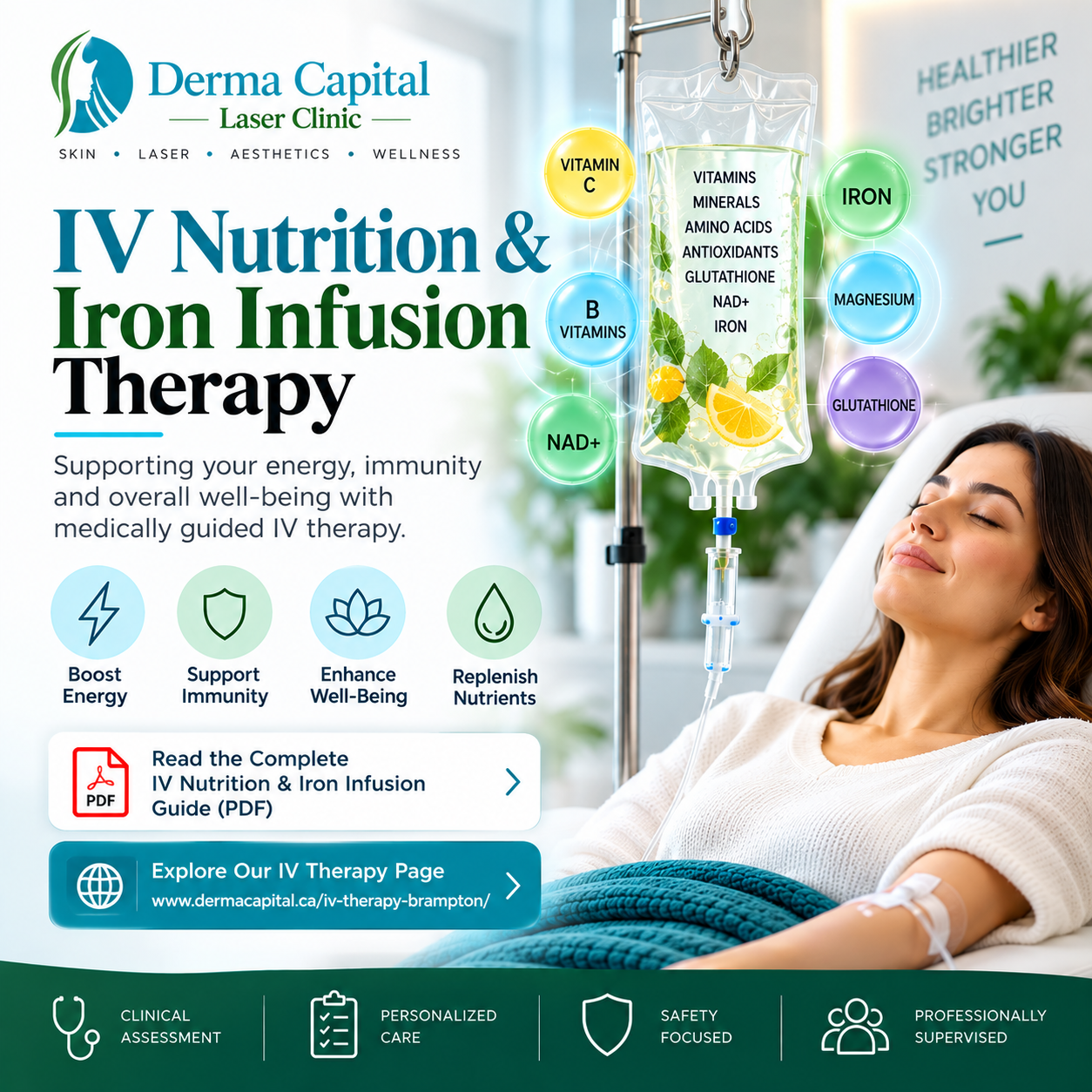
IV Nutrition & Iron Infusion Therapy in Brampton: Complete Guide
When you’re researching IV therapy in Brampton, it’s important to understand more than just what is placed into an IV bag. IV nutrient therapy and iron infusion therapy involve different nutrients, different clinical considerations and different reasons for treatment.
At Derma Capital Laser Clinic, our IV Nutrition & Iron Infusion Therapy resource provides educational information about how intravenous nutrients are delivered, the nutrients commonly discussed in IV therapy, iron deficiency assessment, bloodwork, safety considerations and the importance of individualized clinical assessment.
Explore IV Nutrition & Iron Infusion Therapy in Brampton →
This guide is designed to help you understand the basics before discussing whether IV nutrient therapy or iron infusion may be appropriate for you.
What Is IV Nutrition Therapy?
IV nutrient therapy involves administering selected vitamins, minerals or other nutrients directly into the bloodstream through an intravenous route.
Unlike oral supplements, which travel through the digestive system before nutrients are absorbed, intravenous administration delivers the administered substances directly into circulation.
Your educational guide explains that IV therapy has historical roots in hospital medicine, including fluid administration, critical care and parenteral nutrition, rather than originating solely as a modern wellness treatment.
The route of administration can be particularly relevant when gastrointestinal absorption is impaired or when a clinician determines that intravenous administration is appropriate.
However, IV administration does not automatically mean that everyone needs IV nutrients. The reason for treatment, nutritional status, medical history, laboratory findings and individual circumstances should all be considered.
How Does IV Nutrient Therapy Work?
The main difference between IV and oral supplementation is the route by which nutrients enter the body.
With oral supplementation:
Food or supplement → digestive system → absorption → bloodstream
With IV administration:
IV infusion → bloodstream → circulation
Because IV administration bypasses gastrointestinal absorption, it can provide direct delivery into circulation.
A 2025 peer-reviewed review in Cureus describes IV vitamin therapy as a method that bypasses the gastrointestinal tract and can provide high bioavailability, while also emphasizing that evidence is stronger for some clinical applications than for general wellness use in otherwise healthy individuals.
This distinction is important when discussing IV therapy benefits. Faster or more direct delivery does not necessarily mean that a person will experience a guaranteed improvement or that the effects will last for a particular period of time.
What Does the Evidence Say About IV Vitamin Therapy?
Interest in IV vitamin therapy has grown significantly, particularly in wellness settings.
However, the evidence depends heavily on why IV therapy is being used, which nutrient is administered and the health status of the individual.
Your educational material emphasizes that evidence is mixed and that high-quality randomized controlled trials remain limited for some wellness applications.
The 2025 Cureus review similarly concludes that IV vitamin therapy has recognized clinical applications, including situations involving nutrient deficiencies and malabsorption, while evidence for routine wellness use in otherwise healthy individuals remains uncertain.
For this reason, responsible communication is important.
Rather than promising that IV therapy will cure a condition or guarantee more energy, it is more appropriate to discuss potential therapy in terms such as:
- Supports
- May help
- Plays a role in
- May be considered
- Used as adjunctive therapy
This approach is also consistent with the responsible communication principles in your final educational guide.
What Nutrients Are Used in IV Therapy?
Depending on the clinical assessment and formulation, IV nutrient therapy may involve different vitamins, minerals or other nutrients.
Your educational material discusses several commonly referenced nutrients.
Vitamin C IV Therapy
Vitamin C is an essential water-soluble vitamin involved in a variety of normal physiological processes.
The educational material discusses intravenous vitamin C in comparison with oral supplementation and explains the difference in how the two administration routes deliver vitamin C.
IV vitamin C should be considered in the context of the individual’s nutritional and clinical circumstances rather than as a universal wellness treatment.
B-Complex IV Therapy
B-complex vitamins include several B vitamins involved in normal metabolic processes.
Your educational guide discusses their roles in areas such as:
- Energy metabolism
- Normal cellular processes
- Nervous system function
- Nutritional support
It also highlights that excessive intake of some B vitamins can cause adverse effects, which is one reason individualized dosing and appropriate clinical oversight are important.
Vitamin B12
Vitamin B12 is an essential nutrient involved in normal neurological function and red blood cell formation.
Vitamin B12 may be particularly relevant when a deficiency has been identified or when there are clinical reasons to consider supplementation.
The appropriate form and route of supplementation depend on the individual’s circumstances.
Magnesium
Magnesium is an essential mineral involved in numerous physiological processes.
It is also one of the nutrients discussed in traditional IV formulations such as the Myers’ Cocktail.
As with other nutrients, the appropriate amount and method of administration should be determined based on clinical circumstances.
Glutathione IV Therapy
Glutathione is an antioxidant compound discussed extensively in IV therapy literature and wellness settings.
Your educational material discusses glutathione in relation to antioxidant activity, skin-related applications and other proposed uses, while also identifying potential adverse reactions associated with excessive or inappropriate use.
This is another area where it is important to distinguish physiological roles and proposed applications from proven clinical outcomes.
NAD+ IV Therapy
NAD+, or nicotinamide adenine dinucleotide, is a coenzyme involved in cellular energy metabolism.
Your educational guide discusses NAD+ in relation to:
- Cellular energy
- Metabolism
- ATP production
- Circadian processes
- Cellular function
- Aging-related research
The guide also notes that individual responses and the available evidence can vary.
What Is a Myers’ Cocktail IV?
The Myers’ Cocktail is a nutritional IV formulation discussed in your educational material.
The guide attributes its development to Dr. John Myers in Baltimore during the 1970s and describes formulations containing combinations of:
- B vitamins
- Vitamin C
- Magnesium
- Calcium-related ingredients
Administration time, formulation and dosing should be individualized according to clinical assessment.
Your guide also notes that patients may experience effects such as mild discomfort, dizziness or flushing and that first-time patients may receive individualized dosing and monitoring.
Potential Benefits of IV Nutrient Therapy
People often search for IV therapy benefits in Brampton, but benefits should be discussed carefully because the evidence varies according to the specific nutrient, indication and patient.
IV nutrient therapy may be considered in selected situations involving:
Nutrient Replenishment
When a clinically relevant nutrient deficiency has been identified, appropriate nutrient replacement may form part of an individual’s treatment plan.
Malabsorption
Some gastrointestinal conditions can interfere with nutrient absorption. In selected circumstances, an alternative route of administration may be considered.
Direct Nutrient Delivery
IV administration delivers nutrients directly into circulation rather than requiring gastrointestinal absorption.
Individualized Nutritional Support
Different formulations may contain different combinations of nutrients depending on the individual’s clinical requirements.
Importantly, IV therapy should not be promoted as a guaranteed solution for fatigue, immunity, aging, athletic performance or general wellness. Current evidence for many elective wellness claims remains limited.
IV Therapy Safety: What You Should Know
IV therapy involves inserting a needle and administering substances directly into the bloodstream. That means safety and appropriate clinical procedures are important.
Potential IV-related complications can include:
- Infiltration
- Hematoma
- Phlebitis
- Thrombophlebitis
- Extravascular injection
- Intra-arterial injection
- Air embolism
- Infection
- Nutrient overload
- Medication or nutrient interactions
Your educational material also emphasizes emergency preparedness and appropriate clinical monitoring.
The risks and suitability of IV therapy should therefore be discussed during an appropriate assessment rather than treating IV therapy as a routine procedure suitable for everyone.
What Is Iron Infusion Therapy?
Iron infusion therapy is a method of administering iron intravenously.
It may be considered for selected patients when iron deficiency has been identified and oral iron is not appropriate, is poorly tolerated or has not provided an adequate response.
For example, British Columbia’s clinical guideline states that oral iron is generally first-line treatment and that IV iron may be considered when there is inadequate response to oral iron, intolerance to oral iron or ongoing blood loss.
This is why an iron infusion in Brampton should begin with appropriate assessment rather than simply requesting an infusion based on symptoms.
Who May Be Considered for Iron Infusion?
Depending on the clinical circumstances, IV iron may be considered when there is:
- Documented iron deficiency
- Inadequate response to oral iron
- Intolerance to oral iron
- Significant gastrointestinal side effects from oral iron
- Malabsorption
- Certain gastrointestinal conditions
- Certain bariatric surgery histories
- Ongoing blood loss
- Laboratory findings consistent with iron deficiency
The cause of iron deficiency is also important.
Iron deficiency is not simply a number on a blood test. Identifying why iron is low can be an important part of appropriate clinical management.
What Blood Tests Are Used Before an Iron Infusion?
One of the most important parts of an iron assessment is reviewing appropriate laboratory information.
Ferritin
Ferritin is commonly used to assess iron stores and is an important test when evaluating iron deficiency.
Clinical guidelines identify ferritin as the preferred initial laboratory test for diagnosing iron deficiency, while emphasizing that results need to be interpreted in clinical context.
Transferrin Saturation (TSAT)
TSAT provides information about iron availability and may be considered alongside ferritin and other laboratory findings.
Hemoglobin
Hemoglobin is reviewed when assessing anemia and overall blood status.
ESR and CRP
Inflammatory markers may provide additional context when interpreting iron-related laboratory findings, particularly because ferritin can be affected by inflammation.
The final IV education guide discusses ferritin, TSAT, hemoglobin, ESR, CRP and platelet findings as part of a broader assessment.
Oral Iron vs IV Iron
Oral and intravenous iron are different treatment approaches.
| Feature | Oral Iron | IV Iron |
|---|---|---|
| Administration | By mouth | Intravenous |
| Absorption | Through gastrointestinal tract | Directly into circulation |
| Treatment duration | Often requires ongoing treatment | May require fewer treatment sessions depending on formulation and iron requirement |
| Gastrointestinal effects | Can occur | Different adverse-effect profile |
| Clinical monitoring | Depends on treatment | Important during infusion |
The choice between oral and IV iron should be based on the individual’s clinical circumstances rather than assuming that one route is appropriate for everyone.
Iron Infusion Assessment & Monitoring
Before an iron infusion, clinical assessment may include reviewing:
- Medical history
- Current symptoms
- Previous iron treatment
- Oral iron tolerance
- Relevant bloodwork
- Medical conditions
- Medications
- Previous allergic or hypersensitivity reactions
During treatment, appropriate monitoring of the IV site and the patient’s response is important.
The final educational guide specifically discusses preventing IV extravasation, including appropriate IV access, confirming IV patency and monitoring the infusion site.
What Are the Possible Side Effects of Iron Infusion?
As with any medical treatment, IV iron can have potential adverse effects.
Your educational material discusses possible reactions including:
- IV-site irritation
- Nausea
- Diarrhea
- Hives or urticaria
- Headache
- Hypotension
- Muscle cramps
- Hypersensitivity reactions
Serious hypersensitivity reactions are uncommon but can potentially occur, which is why appropriate clinical monitoring and emergency preparedness are important.
Iron overload is another important consideration. Iron therapy should therefore be based on appropriate assessment rather than administered when iron stores are already sufficient.
Is IV Therapy Suitable for Everyone?
No.
IV nutrient therapy and iron infusion are not automatically appropriate for every person.
Suitability can depend on:
- Medical history
- Current medications
- Nutritional status
- Laboratory results
- Existing medical conditions
- Allergies or previous reactions
- The specific nutrient or iron formulation
- The reason for treatment
A proper assessment helps determine whether IV therapy is appropriate and what type of treatment, if any, should be considered.
IV Nutrition & Iron Infusion Therapy in Brampton
If you’re researching IV therapy in Brampton, understanding the treatment is an important first step.
At Derma Capital Laser Clinic, our IV Nutrition & Iron Infusion Therapy resource is designed to provide educational information about IV nutrient delivery, commonly discussed nutrients, Myers’ Cocktail, Vitamin C, Glutathione, B-Complex, NAD+, iron infusion, bloodwork, safety and clinical assessment.
You can explore the complete IV Nutrition & Iron Infusion Therapy page to learn more.
You can also read the complete educational PDF:
Read the Full IV Nutrition & Iron Infusion Therapy Guide
Frequently Asked Questions
What is IV nutrition therapy?
IV nutrition therapy delivers selected vitamins, minerals or other nutrients directly into the bloodstream through an intravenous route.
What is an iron infusion?
An iron infusion delivers iron intravenously and may be considered for selected patients with iron deficiency when oral iron is unsuitable, poorly tolerated or insufficient.
Is IV therapy better than oral vitamins?
Not necessarily. The appropriate route depends on the individual’s nutritional status, medical circumstances and reason for treatment. Oral supplementation remains appropriate for many people.
What blood tests are important before iron infusion?
Depending on the clinical situation, assessment may include ferritin, hemoglobin, TSAT and inflammatory markers such as ESR or CRP.
How long does an IV infusion take?
Treatment time depends on the specific formulation, dose and clinical protocol. Your final educational guide notes that Myers’ Cocktail administration may take approximately 30–90 minutes, but treatment times can vary.
Are IV nutrient treatments safe?
IV treatment is an invasive procedure and can carry risks. Appropriate patient assessment, sterile technique, monitoring and clinical preparedness are important.
Can IV therapy guarantee more energy?
No. Individual responses vary, and current evidence does not support guaranteeing a particular outcome from general wellness IV therapy.
Learn More About IV Therapy at Derma Capital Laser Clinic
Understanding your treatment options is an important part of making informed healthcare decisions.
If you’re considering IV nutrition therapy or iron infusion in Brampton, start by learning about the treatment, potential benefits, risks, bloodwork and clinical considerations.
Explore the complete IV Therapy page:
IV Nutrition & Iron Infusion Therapy in Brampton
Read the complete educational PDF:
IV Nutrition & Iron Infusion Therapy Guide (PDF)
For other aesthetic and skin treatments, you can also explore Derma Capital’s existing services, including Micro-Needling in Brampton and Acne Therapy in Brampton.
Medical Disclaimer
This article is intended for general educational purposes and does not replace individualized medical assessment, diagnosis or treatment. IV nutrient therapy and iron infusion may not be appropriate for everyone. Treatment decisions should be based on an individual’s medical history, clinical assessment, laboratory findings and other relevant factors. Potential benefits, risks, contraindications and treatment options should be discussed with an appropriately qualified healthcare professional.